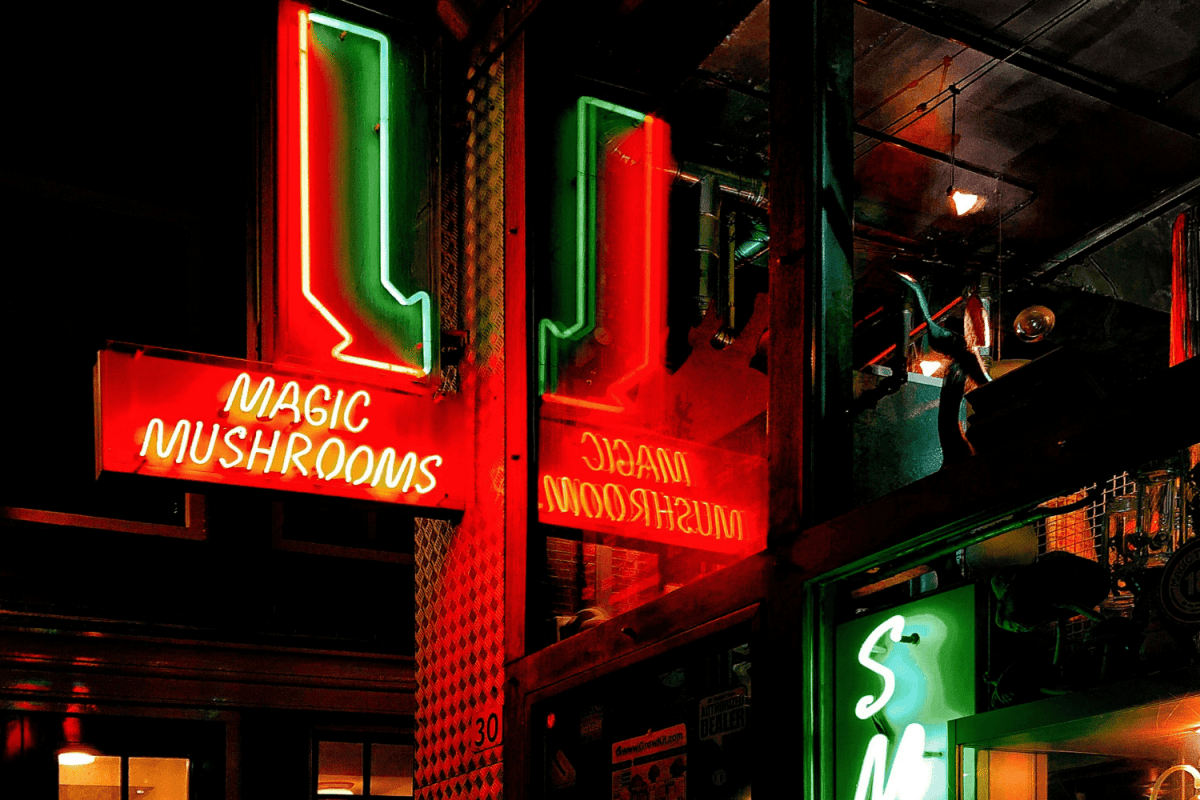
The question of whether magic mushrooms are legal concerns many interested parties and researchers. The clear answer upfront: No, in Germany, psychedelic mushrooms are not legal. However, in this article, we will delve deeper: We will clarify why it is legally prohibited to buy magic mushrooms and what consequences users face if caught with them. So, if you've always wanted to learn more about this topic, this article is for you.
Since the legal classification of psychedelic mushrooms in Germany is a complex and sensitive topic, we have structured the following article to provide you with a clear introduction. It is divided into several sections so that you can quickly find the information you need:
Table of Contents:
1. Why are magic mushrooms not legal? 1.1 What exactly is prohibited? 2. Penalties to expect for legal violations 3. Are alternatives to magic mushrooms legal? 3.1 What about analogues? 3.2 The legal situation regarding grow kits 4. Are magic mushrooms legal in other countries? 5. Conclusion: Legal risks of possessing magic mushrooms
Why are magic mushrooms not legal?
The reason why psychedelic mushrooms are not legal is the psychotropic psilocybin they contain. This active ingredient is capable of inducing potent psychedelic effects such as hallucinations and synesthesia. Therefore, the mushrooms and their active ingredient fall under the German Narcotics Act (BtMG). Well-known representatives of these mushrooms are members of the Psilocybe family, such as Psilocybe azurescens and Psilocybe cyanescens.
What exactly is prohibited?
The mushrooms are listed in Annex 1 of the BtMG. Accordingly, any handling of mushrooms containing the active ingredient is punishable under Section 29 (1) of the BtMG. This includes acquisition, cultivation, and possession. Therefore, it is not only prohibited to buy magic mushrooms, but also to cultivate them for personal use. However, penalties are not only for customers. Import, export, and any trade are also punishable.

Penalties to expect for legal violations
If someone is found guilty of one of the offenses listed above, severe penalties are to be expected. Even with proven cultivation, import, and possession, even of small quantities, imprisonment of up to five years can be expected according to Section 29 (1) of the BtMG.
If a larger quantity is found, it constitutes the offense of "narcotics trafficking in a non-small quantity." In this case, imprisonment of up to fifteen years can be imposed. However, for determining a "non-small quantity," the weight of the mushrooms is not decisive, but rather the weight of the psilocybin contained. The higher offense applies from 1.7 g of the active ingredient.
There are also no tolerance limits, unlike other substances. Even the possession of small amounts of mushrooms, for example, for microdosing, is punished with the full extent of the law. Despite these considerable penalties, the number of recorded offenses has increased in recent years.

Are alternatives to magic mushrooms legal?
While magic mushrooms are clearly not legal in Germany, there are alternatives that are gaining increasing popularity. To keep you fully informed, the following explains the legal situation regarding analogues and grow kits.
What about analogues?
Research and science never stand still. It's not surprising, then, that synthetic analogues of the active ingredient, such as 4-PrO-MET, are constantly being developed. These are derivatives of the actual active ingredient that are structurally similar but not identical to it. Many interested parties and researchers therefore wonder whether the same legal consequences apply to the possession of these substances.
Generally, this is a gray area. The analogue 4-PrO-MET is currently legal when used for research purposes because this novel synthetic has not yet been covered by the BtMG. However, this legal classification of the substance may change. Therefore, it is advisable to keep an eye on current developments.

The legal situation regarding grow kits
Grow kits are boxes that do not yet contain adult mushrooms, but they do contain the spores from which they can grow. These boxes are generally not punishable, as it is the psilocybin that makes magic mushrooms illegal, and typically the active ingredient has not yet formed in spores.
However, caution is advised here, as it cannot be ruled out that traces of the active ingredient, which may have entered the box during production, could be detected during an examination, which could lead to legal consequences.

Are magic mushrooms legal in other countries?
Finally, we would like to look beyond Germany's borders and consider the legal situation in other countries around the globe. It should be noted that the active ingredient and the mushrooms are illegal in most countries worldwide, but there are some notable exceptions, especially in the USA:
Denver, Oakland, Santa Cruz, and Ann Arbor:These US cities of various sizes voted for the decriminalization of the active ingredient in 2019 and 2020.
Oregon and Colorado:Decriminalization efforts also occurred at the state level in 2020 and 2022. In the states of Oregon and Colorado, psychedelic mushrooms have been classified as legal within a therapeutic setting.
The Netherlands:In the Netherlands, the sale of psychedelic mushrooms containing psilocybin was banned in 2008. However, according to the Dutch public prosecutor's office, possession of small quantities does not lead to punishment. Small quantities in this case refer to 0.5 g of dried or 5 g of fresh mushrooms.
Australia:In Australia, magic mushrooms have been approved for the treatment of treatment-resistant depression since 2023.

Conclusion: Legal Risks of Owning Magic Mushrooms
In Germany, it is therefore not legal to order and possess magic mushrooms. Otherwise, severe penalties can be expected, which can amount to up to fifteen years imprisonment for quantities of 1.7 g of the active ingredient. Although there are analogues that are not yet explicitly covered by the Narcotics Act (BtMG), the classification can change at any time.
In individual administrative districts of the USA and in Australia, it is legal to use magic mushrooms for therapeutic and medical purposes. Whether decriminalization will continue to advance and eventually reach Germany remains to be seen.